


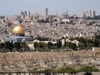
Moriah (מוריה) is the name given to the Temple Mount in Jerusalem, long before the Temple was built there by King Solomon. It is also a popular name among Israeli girls.
The Meaning of the Word
The Midrash offers several explanations.1
- Rabbi Hiyya Rabba explains that it was called Moriah because the Sanhedrin gathered in the Temple, on Mount Moriah, and from there Torah instruction (hora’ah) went out to all of Israel.
- According to Rabbi Yanai, it is called Moriah because it is the place from which fear [yirah] emerges into the world.2
- Rabbi Yehoshua ben Levi said: It is called Moriah because it is from there that G‑d shoots [moreh] at the heathens, and dispatches them down to Gehenna for not accepting His dominion.
- Rabbi Shimon ben Yocḥai said: G‑d was telling Abraham to go to the place that is aligned [ra’ui] corresponding to the heavenly Temple.
- Rabbi Pinchas said: Moriah is the place of dominion [maruta] over the world.
- The Rabbis say: Moriah is the place where incense is offered, just as it says: “I will go to the mountain of myrrh [mor], and to the hill of frankincense.”3 “Mor” is phonetically similar to Moriah. Onkelos likewise rendered it “the land of service” as alluding to the service of the incense, which contained myrrh, spikenard, and other spices.
A more prosaic explanation is given by the medieval Rabbi Shmuel ben Meir (Rashbam), who explains that it is a variant spelling of the “the Amorites” (האמוריה), a nation living in the Holy Land prior to Joshua’s conquest.4
“Land of Moriah”
Moriah first appears in Scripture at the beginning of Abraham’s most dramatic test:
‘And He [G‑d] said, “Please take your son, your only one, whom you love, Isaac, and go away to the land of Moriah, and bring him up there for a burnt offering on one of the mountains, of which I will tell you.”5
According to Rashi, Moriah refers to Jerusalem.6 Interestingly, Moriah (מוריה) and Jerusalem (ירושלם) have the same numeric equivalence (gematria).7
The exact mountain is not specified in this command, and the commentaries explain that this was deliberate. The vague directions were themselves a test, as G‑d wanted to see how devoted Abraham was.8 An alternative explanation is that while Abraham was familiar with the land of Moriah, a region centered around a mountain, he was not familiar with the actual mountain. So G‑d directed him to the land and not the mountain.9
At the summit, Abraham built an altar. G‑d pointed to the altar and announced, “This is the altar Adam built. This is the altar Cain and Abel built. And this is the altar Noah and his sons built after the Flood.”10 It was in that exact spot that Abraham offered his beloved son, Isaac, upon the altar.
At the last moment, G‑d told Abraham he had passed the test and commanded him to take Isaac off the altar. In his stead, a ram was offered. It was then that Abraham proclaimed the spot, “The L-rd will see.” The Hebrew word for “will see,” yireh, is linguistically similar to “Moriah.”11
Ever since, that space has been sacred. Isaac prayed there and referred to it as the field of G‑d.12 Jacob prayed there, and later that night had the famous dream of the ladder that was ascended and descended by angels. It was Jacob who accurately defined that sacred space as the house of G‑d.13 But it was only years later, after the Exodus from Egypt, the conquest of the Land of Canaan, and the coronation of the first Jewish King, that Har Hamoriah was purchased to be the eternal space of the Divine presence housed in the Holy Temple.
David’s Purchase of Mount Moriah
King David purchased Mount Moriah to end a plague of pestilence. During his reign, G‑d spread pestilence throughout the Jewish nation. Having chosen the Divine punishment of pestilence over war and hunger, King David pleaded with G‑d to have mercy on the Jewish people when he saw that 70,000 had already died.
Through the prophet Gad, G‑d instructed King David to build an altar on the threshing-floor of a man named Aravnah, the lord of the citadel that stood on Mount Moriah. This would terminate the plague.
And Aravnah looked afar and he saw the king and his servants passing on towards him: and Aravnah went out and he bowed down to the king with his face to the ground.
And Aravnah said, “Why has the lord my king come to his servant?”
And David said, “To acquire from you the threshing-floor, in order to build an altar to the L-rd, that the plague be stayed from the people.”
All this, Aravnah the king gave to the king. And Aravnah said to the king, “May the L-rd your G‑d accept you.”
And Aravnah said to David, “Let my lord the king take and offer up what seems good in his eyes; behold the oxen for the burnt-offering and the threshing tools, and the [wooden] tools of the oxen for [fire] wood.”
And the king said to Aravnah, “No; for I will only buy it from you at a price; so that I will not offer to the L-rd my G‑d burnt-offerings [which I had received] for nothing.”
And David bought the threshing-floor and the oxen for fifty shekels of silver.14
It was there that David’s son, King Solomon, later constructed the First Holy Temple, which was the center of Jewish life for 410 years. After its destruction by the Babylonians in 423 BCE, and the Jewish people’s subsequent exile, it was rebuilt in 349 BCE and stood for another 420 years. And it is there that the Third Holy Temple will be rebuilt, with the coming of Moshiach and the Final Redemption, may it happen imminently.


Join the Discussion