


On the first night of Rosh Hashanah, after the Ma'ariv service, it is customary to wish one another: L'shanah tovah tikatev ve'techatem l’alter l'chayim tovim - "May you be inscribed and sealed for a good year, for good life immediately."
After the first night, it is not customary to extend this greeting, for it is said that the entirely righteous have by this time already been inscribed for a good life, and one would not want to imply that his friends are not among the righteous. Moreover, each person should consider his fellow as completely righteous, though it may seem otherwise, for man judges only by appearances, while G‑d sees the heart. Perhaps this or that person has repented in thought, and has been judged [by G‑d] to be entirely righteous.
In Sephardic communities, however, it is customary to extend this greeting after the Rosh Hashanah morning service as well.
In candle lighting, the woman says "Blessed are You... Who has commanded us to kindle the light of the Festival" [and some say "of the Day of Remembrance"] and also the She-hecheyanu blessing, where it is customary. The She-hecheyanu is included in the Kiddush recited by the man. (See the section on Erev Sukkot for more on candle lighting.)
- Our Sages taught: Symbols have real meaning. We therefore serve symbolic foods on Rosh Hashanah, that they may stand for the good year we hope to merit. These symbolic foods and their accompanying prayers open the festive meal on the first night of Rosh Hashanah. Among Sephardic communities, they are repeated on the second night.
- We dip the piece of challah used for Ha-Motzi into honey - if one has no honey then sugar is used. Some use both salt and honey. After eating the challah, a slice of sweet apple is taken and is dipped into honey. The blessing of Borei Peri ha-Etz is recited, the apple is eaten, and then the following prayer is said: "May it be Your will to renew for us a good and sweet year."
It is also customary to eat various vegetables over which appropriate prayers are recited, incorporating the sounds of their Aramaic names. Some of these are:
silki [beets] - which suggests the word meaning "to remove." Hence: "May our enemies be removed."
kartii [leeks] - which suggests the word meaning "to cut down." Hence: "May our enemies be cut down."
kara [squash] - which suggests the word meaning "to read." Hence: "May our merits be read before you."
tamri [dates] - which suggests the word meaning "to consume." Hence: "May our enemies be consumed."
Obviously these foods should themselves be tasty, and not bitter or sour.
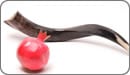
- It is likewise customary to eat a pomegranate and say, "May our merits be as plentiful as the seeds of a pomegranate."
- Some follow the custom of eating the head of a fish or the meat from the head of a sheep, and saying: "May it be Your will that we be at the head and not at the tail." Some specifically eat fish as a symbol of blessing.
All of these foods serve to remind man that he is being judged, and to arouse him to repent. It is exceedingly important to avoid becoming angry on this day. Although the Sages stressed that one must avoid anger throughout the year, it is especially important that one avoid anger on Rosh Hashanah. Instead, one should clothe himself in the joy of G‑d and fill his heart with good will and love so that his behavior too will be a favorable sign.
- It is customary not to eat nuts on Rosh Hashanah, or similar foods that increase phlegm and might disturb one's concentration when praying. Some maintain that the custom of not eating nuts is based on the fact that the gematria [numerical value of the Hebrew letters] of egoz - nut - is equivalent to that of chet - sin, and we do all that we can to avoid any suggestion of sin on Rosh Hashanah.
The later commentators explained that we partake of these symbolic foods on the night of Rosh Hashanah because during the day we do not concern ourselves with material requests, for the prayers offered are meant to express our recognition of G‑d's sovereignty. Nonetheless, though we pray that G‑d's dominion be recognized by all, the fulfillment of our material needs also plays a role in enabling us to occupy ourselves with the concerns of Heaven. Thus, it is appropriate that we allude to these physical needs through the use of symbols.









Join the Discussion